
BREAKING THE CYCLE OF DOMESTIC VIOLENCE
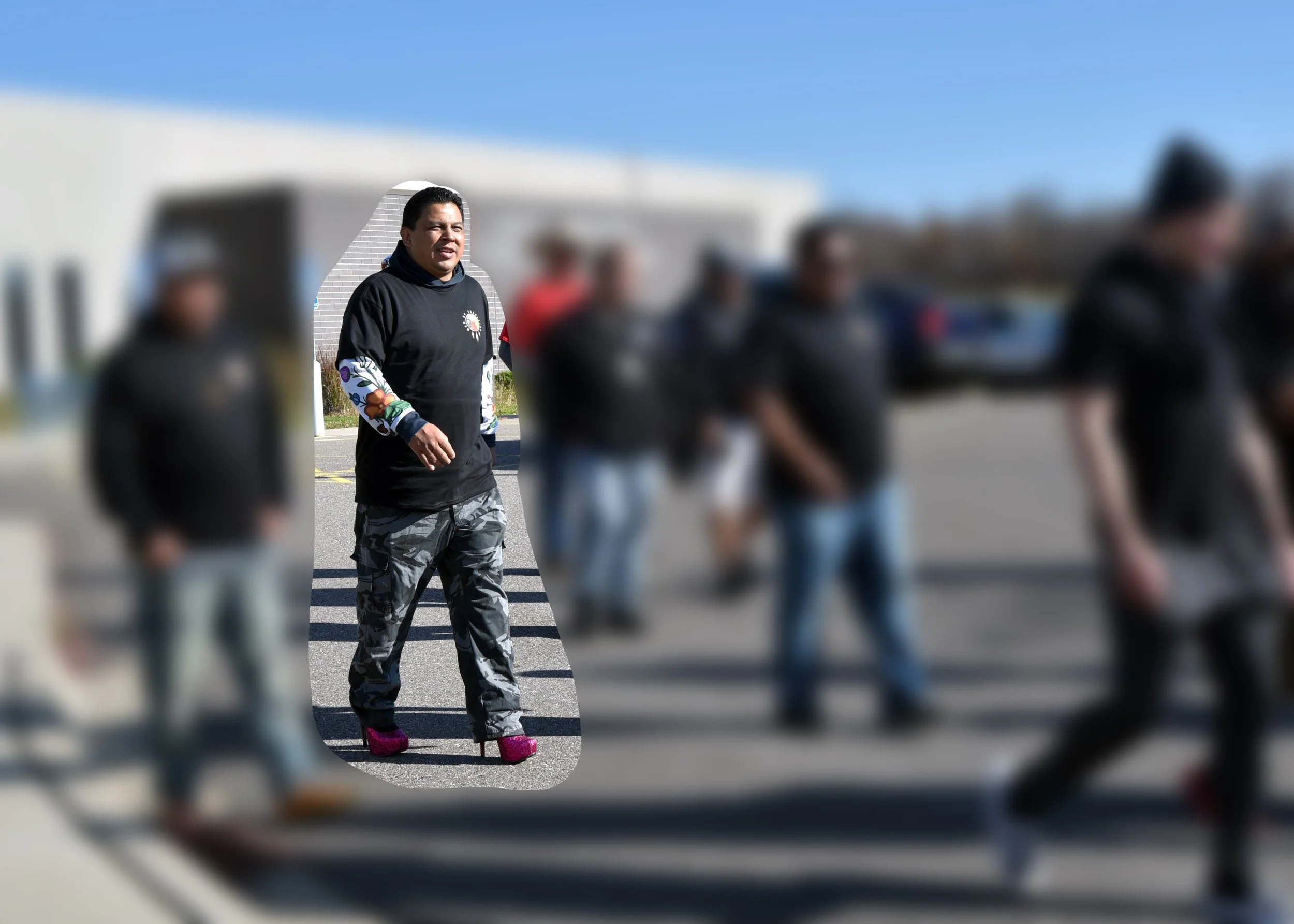
Dan Wind participated in the Walk in Her Mocs event held in October. Walking nearly a mile in a pair of women's shoes is symbolic. Others in the photo have been blurred intentionally. Photo by Vivian LaMoore.
One man's journey to living a sober, violent free life
By Vivian LaMoore, Inaajimowin Editor
Domestic violence touches far too many families, leaving deep wounds that aren't always visible. Nearly one in two women and more than two in five men in the United States have endured intimate partner violence. Every single minute, 32 people are hurt by someone they love.
And in the middle of it all are the children - carrying heartbreak they can't always name. One in four witnesses abuse in their own home, and as they grow, they face a far greater risk of being harmed themselves or repeating the cycle of violence later in life.
Yet even within these painful truths, there is hope. Healing is real. Change is real. With support, accountability, collaboration, and care — from family services programs, victim advocates, the courts, law enforcement, and the abuser's own willingness to change — many are finding their way out of violence and choosing a different future.
For some, that future begins only after confronting a past filled with fear, anger, and harm — and taking the hard, necessary steps of accountability for the pain they have caused.
The sound of fists pounding. The slam of a door. The echo of angry words. The fear in someone he loved - that was the rhythm of Dan Wind's life for years. Drugs, alcohol, and violence weren't chaos to him; they were normal. He hurt the people closest to him over and over, trapped in a cycle that seemed impossible to escape. Arrests and prison stints came and went, but each time, he fell back into the same patterns.
The first time he was arrested over 20 years ago, Dan remembers very little. "It just came out. I was blacked out. I read the police report, and it said I beat her up. I didn't remember any of that. I still don't. I was in disbelief that I could even do that. I ended up almost going to trial, but I took a plea deal to Second Degree Attempted Murder."
He was sentenced to 147 months — almost 12 years - and served seven years in prison. But when he got out, he returned to drinking, drugs, and partying. Prison didn't teach him how to live a sober life — it taught him more violence. "If someone disrespects you or something, you have to fight him, or beat him up. Living with that mentality for a long time, when I did get out, I ran," he said.
Even the last time he laid hands on a woman, Dan says he wasn't under the influence. "She disrespected me... that switch just flipped and I didn't care." Arrests followed. But that moment became a mirror — a point where denial collided with reality.
"I didn't want to live like that anymore," he said. "I knew I would end up the same way or worse. I was done."
Dan qualified for the Domestic Violence Court Program in Mille Lacs County, which forced him to confront the reality of the harm he had caused and the life he had been living. It was terrifying. It was humbling. And for the first time, it offered a chance to break the cycle, take responsibility, and imagine a life he never thought possible.
He entered treatment at Four Winds, completed the program, moved to a halfway house on the Reservation, and then followed the Domestic Violence Court program. "DV Court saved my life," he said.
A central part of the program is participation in what was previously known as a Batterers Intervention Program. The name has been changed to the Domestic Abuse Transformation Program (DATP). "That old name carried a lot of stigma and it labeled people by their worst moment," said Kristen Allord, Victim Services Director. "We wanted a name that aligns with the work we're actually doing. While we always acknowledge the harm that was caused, our focus is on helping participants take responsibility and move forward. The goal is transformation — and transformation doesn't happen overnight. It's a process for change, growth, and accountability. It requires reflection, honesty, and learning new ways of communicating and engaging in relationships. We wanted the name of the program to reflect that journey.
While the program focuses on survivor safety, for the abuser it emphasizes learning to communicate better and develop healthy relationships. Participants work through real-life scenarios to practice accountability. "I see it happening. I see the changes that are taking place," Allord said.
Entering the 26-week program is usually court-ordered, though some attend voluntarily. Comments from graduates are generally positive. "It really helped me look deeper into what I did," Dan said. "I was using most of the time when I did it. But I learned the issues were with me and my past, and like growing up, seeing it happen. It wasn't the drugs and drinking that caused me to hurt them. My anger came from somewhere else. My childhood traumas stayed with me. I stayed with my Grandma in the summertime and I saw stuff in the neighborhood. It seemed normal. But I look back now and know that was the root. The drugs and drinking just kind of….. made me not care."
Allord explained that while DATP staff are not therapists or counselors, they follow the Duluth model incorporating culture through Noojimo iwewin izhitwaawin, Healing Through Culture department. "It's about accountability and restoring awareness. Everything is a choice. We help them learn to make better choices. It's about accountability over excuses," she said. "Sometimes when they first come in you hear them say things like, Well, if she wouldn't have done this, I wouldn't have done that.' But later they learn, 'I chose not to do that. Instead, I did this.' That's how I measure success."
The Mille Lacs Band DATP program is grant-funded and free to participants, incorporating Anishinaabe culture and the Grandfather Teachings. Throughout his healing journey, Dan has embraced cultural practices: attending ceremonies, sitting on the drum, singing, participating in Miidewin, fasting, sweating, and assisting with Traditional Healing at cultural grounds. He has been sober since March 13, 2015.
"I won't ever be able to make up for what I did. That's there and it will be there forever," Dan said. "But if I can help even one person — help one woman realize she doesn't have to stay in a toxic relationship, or help one guy see he can change - I want to do that. I put myself in their shoes — it's hard, you know? And I was that guy who was stuck. I want to be empathetic to the victims and provide a safe environment for anyone."
Dan was approached to speak at the Domestic Violence Walk in Her Mocs event. "I didn't want to take away from the victims. I asked my mentor Todd (Mikinaak), and he said I should do it. It would help bring awareness, and maybe inspire men to look at what they did, or what they do, differently, and get help."
Sharing his story was difficult. "I would never say I fully understand her part. For the past seven years, I have thought about it a lot. I just try to put myself in the role of the women — especially my victims. I want to say I'm sorry. I know they won't probably care. I know I won't ever be able to take away their experiences and the trauma. So, all I can do is — I want to be empathetic and help our women not have to live with that."
Dan hopes to start a men's warrior teachings and accountability group, returning to traditions of men taking care of women and children. "I really want the women in our community to feel safe."