October 29, 2026
By Charlie Lippert, Air Quality Specialist, Department of Natural Resources, Environmental Programs, Mille Lacs Band of Ojibwe
The proposed Tamarack nickel mine in northern Minnesota has been promoted as a way to supply the metals needed for electric vehicle batteries and the transition to clean energy. But as battery technology advances and alternatives to newly mined nickel become more widely available, an important question remains: Is the potential risk to Minnesota's water resources necessary to support a cleaner energy future?
For the Mille Lacs Band of Ojibwe, that question goes beyond the immediate environmental concerns. Anishinaabe teachings remind us to consider how the decisions we make today will affect the next seven generations. When those decisions involve mining, water quality, and the long-term health of the land, the consequences could extend far beyond our lifetimes.
The argument for the Tamarack mine has largely followed a straightforward narrative: Moving away from fossil fuels requires batteries, batteries require nickel, and the United States produces relatively little nickel. By that reasoning, mining nickel in Minnesota becomes part of the climate solution, and opposing the mine can be portrayed as opposing clean energy.
But the technology - and the facts surrounding that argument — are changing.
BATTERY FORMULATIONS ARE CHANGING
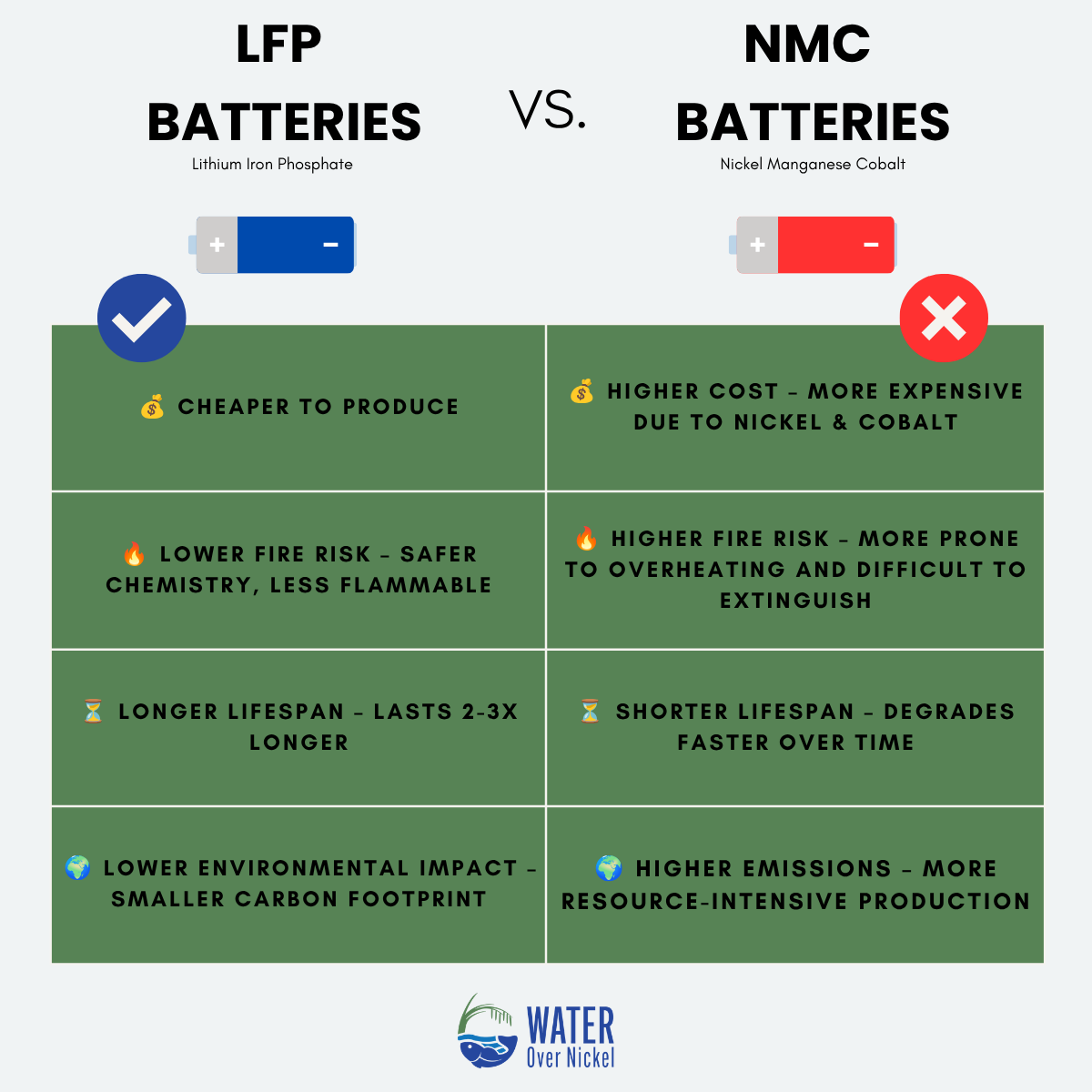
Not all batteries use nickel. The two dominant chemistries in electric vehicles are NMC — nickel, manganese, and cobalt — and LFP, which stands for lithium iron phosphate. LFP contains no nickel and no cobalt at all.
For years, analysts expected NMC to dominate because it packs more energy into the same weight. However, the International Energy Agency reported that LFP accounted for more than 55 percent of electric vehicle batteries deployed globally in 2025, up from nearly 50 percent in 2024, and that LFP packs were more than 40 percent cheaper per kilowatt-hour. The reasons are practical rather than ideological: LFP is cheaper, safer, and lasts longer.
LFP batteries are already widely used to store electricity generated by solar panels and wind turbines. Because these batteries remain in one place rather than powering vehicles, their weight is less important. Sodium-ion batteries, which do not use lithium or nickel, have also begun moving into commercial production.
None of this means nickel demand disappears. High-nickel batteries still have advantages in long-range vehicles and some industrial uses. But the claim that the energy transition depends on new nickel mining is considerably weaker in 2026 than it was in 2022.
RECYCLING IS THE OTHER HALF
Every new battery will eventually reach the end of its useful life and should be recycled. Modern recycling methods can recover more than 90 percent of the valuable metals, including nickel, cobalt, and lithium, from used batteries. Some processes can recover approximately 98 percent of the nickel alone.
Technology is not the constraint. Batteries have to reach a recycler to be recycled, and much of what is discarded in this country never does. That points to questions Minnesota could ask that have nothing to do with a mine. What share of the State's battery waste is actually captured? Would rules requiring manufacturers to take back what they sell improve it? Could the State support recycling and refining capacity rather than only extraction? Metal recovered from a battery in Minnesota is domestic supply in the same sense that metal from a Minnesota mine is, and it arrives without a tailings basin.
The ore leaves Minnesota — and the destination just changed.
Where the ore goes after it leaves the proposed Tamarack mine matters because processing the rock creates additional environmental impacts, including waste materials known as tailings.
On September 10, one day after the Band filed its comments and four days before the comment period closed, Talon Metals announced that ore from Tamarack would be processed at the company's Humboldt Mill in Marquette County, Michigan, rather than the previously proposed Beulah Minerals Processing Facility in Mercer County, North Dakota.
Talon acquired Humboldt and the operating Eagle nickel-copper mine that feeds it from Lundin Mining in 2026.
I encourage Band members to pay attention to two things:
The first is where the metal goes. Nothing from Tamarack would be processed in Minnesota. The rock comes out of the ground here, and everything afterward - crushing, flotation, the production of nickel and copper concentrates, and the tailings that result - would happen in Michigan. Minnesota would still be the location for the mine, the dewatering, the discharge, and the closure obligation.
The second is how settled the project is. Both scoping documents describe two off-site processing facilities, neither of which will be studied in the Environmental Impact Statement because Minnesota lacks jurisdiction over activity in another state. The Band objected to that reasoning, arguing that where a facility sits is a different question from whether its effects should be analyzed, and that a mine whose stated purpose includes shipping ore to a particular mill is directly connected to that mill.
Four days before the comment period closed, one of the two named facilities was cancelled and the other selected. In other words, the proposed processing arrangement changed while the public was still reviewing and commenting on documents that described a different plan. On September 9, the Band asked the DR to specify what future changes would require a new environmental review rather than a permit amendment, and listed a change in the location of ore processing as one such change.
WHAT A PERMIT DOES & DOES NOT DECIDE
The clean-energy framing also ignores the reality that a permit to mine does not specify what the metal becomes.
Concentrate from Humboldt enters a global market. Nothing in a Minnesota mining permit requires nickel to end up in an electric vehicle battery rather than in stainless steel, which remains the largest single use of nickel worldwide. There is no guarantee that nickel mined at Tamarack would end up in electric vehicle batteries. Like other commodities, nickel is sold on the market to buyers who may use it for many different purposes.
What the Band has said, and what it has not
The Band's September 9 comments to the DNR did not argue that nickel is unnecessary or that markets will not need it. That is deliberate. Those comments are a legal document about the adequacy of an environmental study, and they rest on what the State's own documents say and fall to say.
The Band's position there is narrower and harder to answer: whatever the metal is for, the study must be honest about the cost of mining it here. The study must examine how sulfate could move through downstream wild rice waters and how it could affect mercury levels in fish. It must predict how far groundwater levels could drop and what wetlands or other resources might be affected. And it must address what happens after the mine closes, including whether water treatment could be needed for decades or even indefinitely — and who would pay for it. Those questions are separate from the conversation around batteries.
One connection is worth noting. The Humboldt Mill processes ore from the Eagle Mine, an underground nickel-copper mine in Michigan operating since 2014. Eagle appears in the Band's comments for an unrelated reason: its own monitoring recorded groundwater several feet below the calculated baseline at one location, which the operator attributed to dewatering and well pumping at rates far below what is projected at Tamarack. The Band cited that record and asked the DNR to state, in feet and at named locations, how far the water table is predicted to drop here.
The question underneath
The larger question remains: Do we really have to choose between clean energy and clean water?
Advances in battery technology, improvements in recycling, and alternatives to newly mined nickel suggest that the choice may not be as simple as it has been presented. The decisions we make today are not just about what we can extract from the ground, but what we can reuse, what we can protect, and what we leave for future generations.
Our teachings remind us to consider the seventh generation when making decisions. A battery may last 15 years. A mine's water obligations could last forever.
The question isn't whether we need clean energy. It's whether achieving it requires putting clean water at risk — and what kind of world we intend to leave for those who come after us.
Water Over Nickel is a project of the Mille Lacs Band of Ojibwe. The Band's full comments on the Tamarack Mining Project scoping documents were submitted to the Minnesota Department of Natural Resources on September 9, 2026.