
Voices Matter
August 5, 2026
By Vivian LaMoore, Inaajimowin Editor
Sometimes protecting a place begins simply by showing up. Hundreds of people did just that in August, filling public meetings in McGregor and Blaine to make their voices heard as the Minnesota Department of Natural Resources considers the scope of the environmental review for Talon Metals’ proposed Tamarack nickel-copper mine in Aitkin County.
For members of the Mille Lacs Band of Ojibwe, the issue hits especially close to home.
The proposed underground mine would be located just over a mile from the homes of some Band members, within the Band’s ancestral homelands and amid an interconnected system of wetlands, peatlands, groundwater, streams and rivers that supports communities, wildlife, and manoomin. Band leaders, members, employees and allies attended both DNR meetings, many wearing blue in support of clean water.
More than 350 people attended the August 5 meeting at McGregor High School, where speakers were selected through a random drawing. Chief Executive Virgil Wind, District II Representative Raina Killspotted and Commissioner of Natural Resources Kelly Applegate were among those given an opportunity to formally address the DNR. Several Band members also spoke.
At the heart of the Band’s comments was a consistent message: Before decisions are made, the potential consequences must be fully understood.
Chief Executive Wind said protecting the Band’s people today —and generations yet to come — is among his fundamental responsibilities.
“What happens here will not stay here,” Wind told the crowd. “These connected waters carry the consequences downstream to communities across Minnesota and beyond.”
Wind said the Band’s review of the draft scoping document identified significant unanswered questions, including potential impacts to Tribal and community health, treaty-protected resources, traditional foods and medicines, and the amount of water the mine would use and how that water would ultimately be treated and discharged.
He also stressed that responsibility cannot disappear when mining operations end.
“If this project is permitted, accountability cannot end when mining ends,” Wind said. “The company must remain responsible for long-term treatment, restoration, and cleanup. Those costs must not be passed onto the Band, nearby communities, or Minnesota taxpayers.”
For Killspotted, the proposed mine is not an abstract policy debate. It is being considered in the community she represents.
“For the people of District II, this mine is being proposed in the place we call home,” she said. “These are the roads we travel, the waters we fish, the forests we hunt and gather in, and the places where we raise our children.”
Killspotted said residents are asking questions about drinking water, traffic, noise, industrial activity, public safety and what a changing landscape could mean for everyday life. They are also asking whether their voices will truly influence the process.
“The people who live closest to this proposed mine should not carry the greatest risks while having the least influence,” she said.
Killspotted urged the DNR to give meaningful weight to both Indigenous knowledge and the lived experiences of local residents.
“As the Non-Removable Mille Lacs Band of Ojibwe, this is our only home — our forever home,” she said. “We do not have the option to move elsewhere if this landscape is damaged.”
FOLLOWING THE WATER
Applegate focused his comments on the science — and particularly on understanding water as a connected system rather than examining only the immediate mine site.
“Water does not stop at a property line, project boundary, or discharge point,” he said. Water from the mine area moves through ditches and tributaries into the Tamarack River, Prairie River, Big Sandy Lake, and eventually the Mississippi River. That interconnectedness, Applegate said, means the environmental analysis must also look beyond the project’s boundaries.
Among the Band’s concerns are sulfate and mercury, groundwater drawdown, impacts to wetlands and peatlands, and the need for adequate baseline information about manoomin and other sensitive resources before mining begins.
Without that baseline information, Applegate said, it could be difficult to reliably measure future harm or determine whether the mine caused it.
Talon has said new technologies and approaches will allow the mine to operate safely. Applegate said those claims should be demonstrated through transparent, independent and project-specific analysis — not accepted on assurances alone.
“Our people and waters should not bear the risk of proving whether Talon’s approach works,” he said.
A YOUNG VOICE FROM EAST LAKE
The concerns expressed by Band leadership were also deeply personal for Band members who spoke during the public comment period.
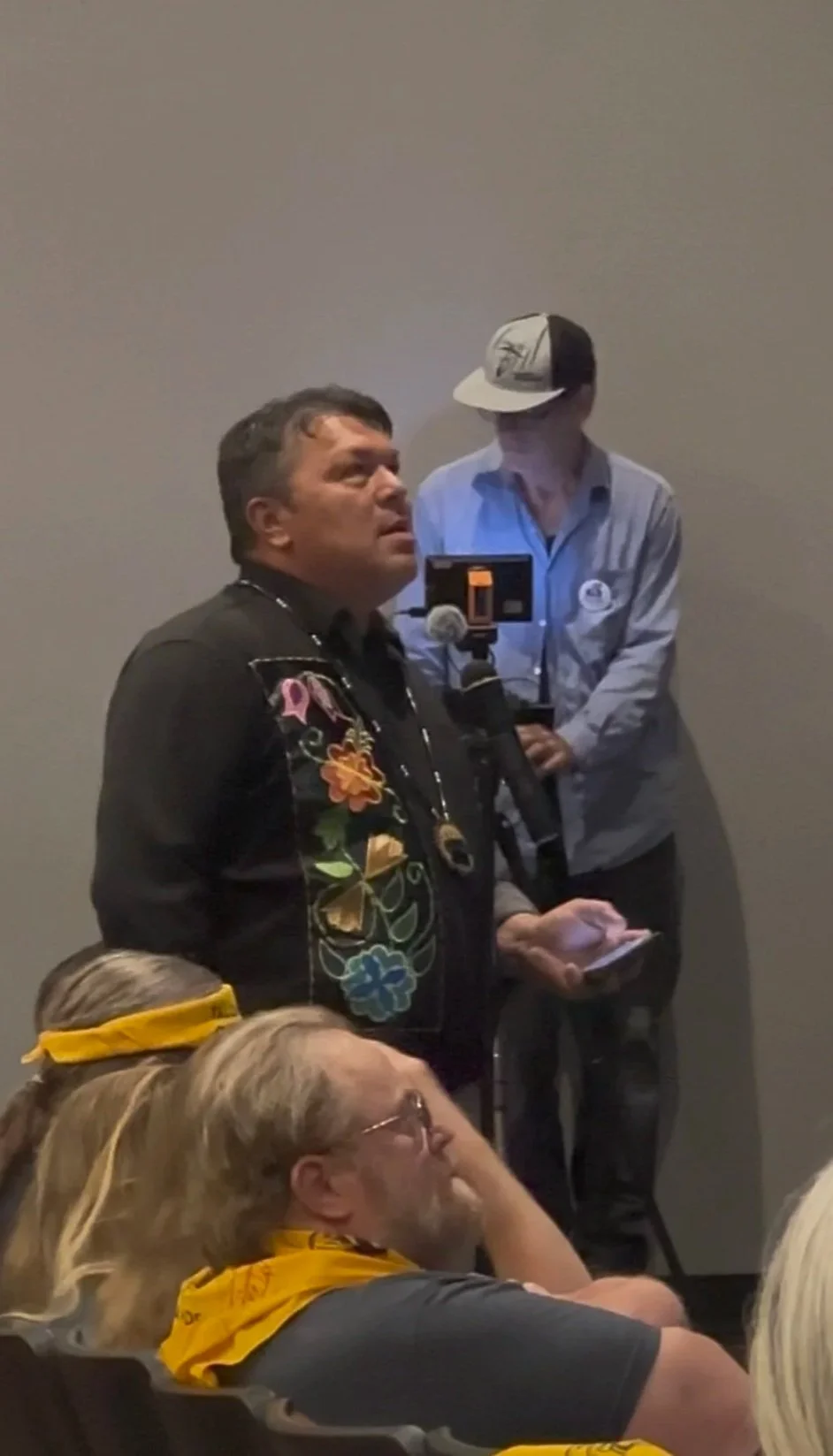
Curtis Jackson, a young Band member from Minisinaakwaang, or East Lake, was the 44th and final speaker selected at the McGregor meeting. Speaking about his connection to the land and the responsibility to protect it for those who come next, Jackson invoked the generations who came before him.
“I do not stand alone here today,” Jackson said. “With me are the ancestors of hundreds of years of resistance, perseverance,
and resilience.”
“Throughout everything we have been through — genocide, assimilation, Manifest Destiny — we are still here. And now, this mine threatens my ancestral homelands and the next seven generations of our kin.”
Jackson said caring for the Earth is a responsibility passed from one generation to the next.
“My Elders and ancestors fought for these lands, and the fight continues today,” he said. “We will not back down.” He ended simply: “Water is life. And with this mine, we are risking our lives.”
His comments received a standing ovation.
VOICES CARRY TO BLAINE
The call for Band members to make their voices heard continued one week later at the DNR’s second public meeting August 12 at the National Sports Center in Blaine.
The Office of the Chief Executive provided free charter bus transportation from the Mille Lacs Band Government Center for Band members and employees who wanted to participate. Wind, Band member Brooke Houle and Chief Executive’s Office staff member Kiana Morrison were among those given time to speak about concerns surrounding the proposed mine and the environmental review.
Although the two public meetings have ended, the opportunity to be heard has not.
The DNR’s public comment period on the environmental review scoping documents remains open through September 14. Written comments may still be submitted.
For Wind, the responsibility extends well beyond one mine proposal or one generation.
“Our ancestors cared for these waters so they would sustain us,” he said. “Now, it is our turn to ensure they will sustain those who come after us.”
There is still time to make your voice matter. Visit WaterOverNickel.com to find a step by step guide to submitting a written comment.