WILD OJIBWEMOWIN BROADCAST GOES VIRAL: Minnesota’s historic telecast is the first of its kind
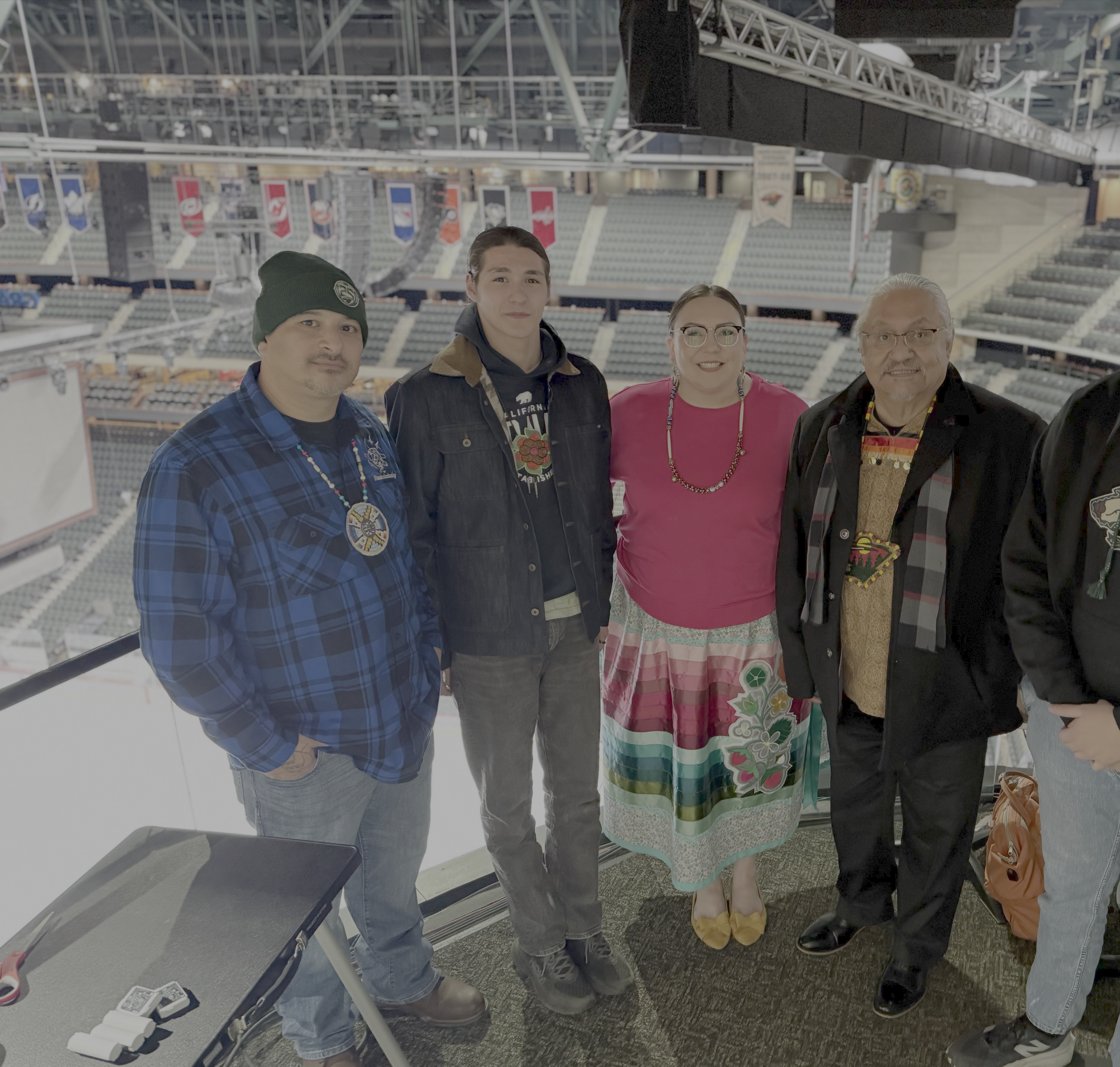
Ombishkebines Gonzalez, Ginoonde Buckholtz, Baabiitaw Boyd, and Maajiigoneyaash Jourdain at the Grand Casino Arena for the history-making Minnesota Wild vs. Colorado Avalance game broadcast entirely in Ojibwemowin on FanDual Sports Network. Submitted photo.
By Vivian LaMoore, Inaajimowin Editor
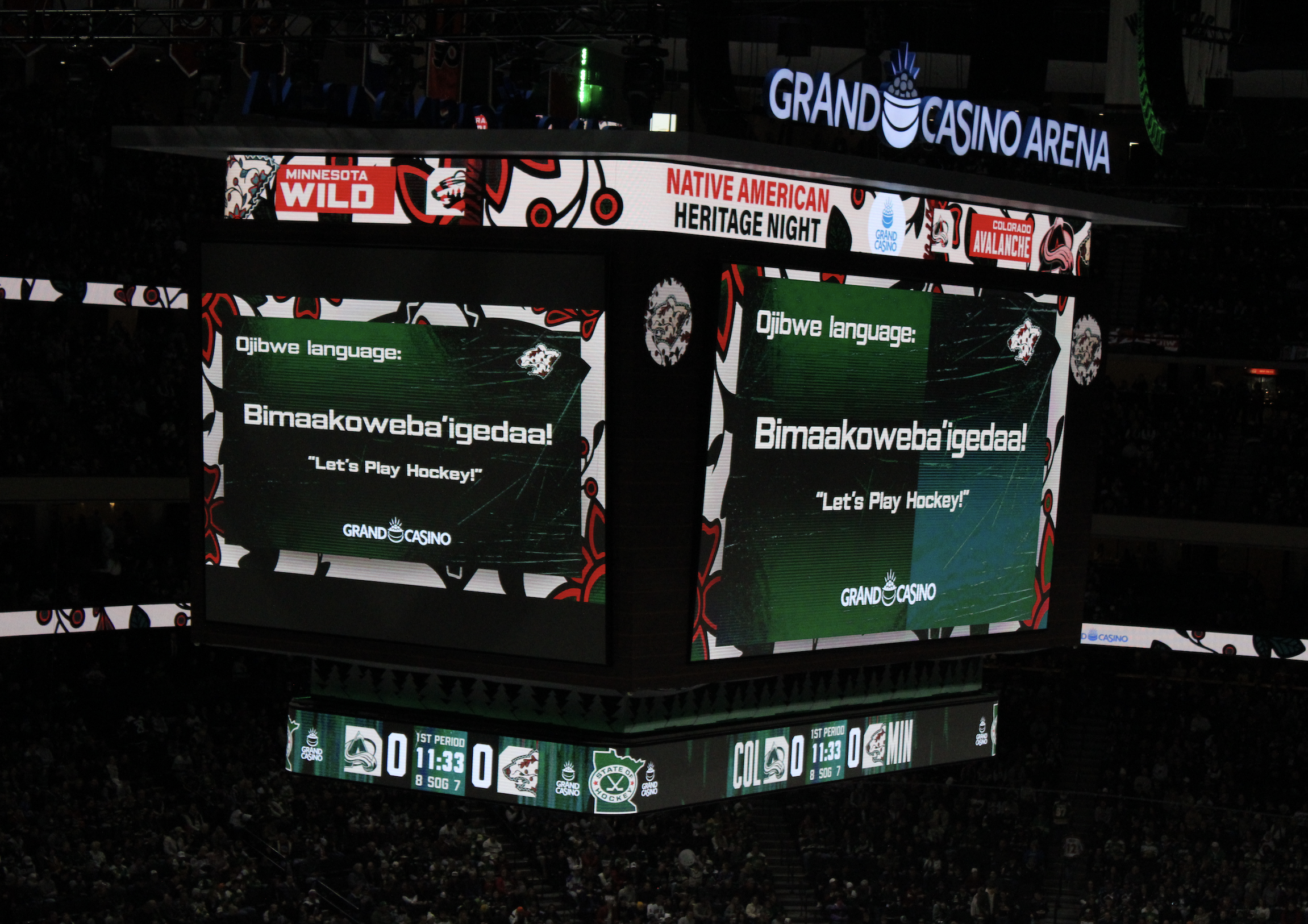
"Bimaakoweba' igedaa!" means, let's play hockey!
Those words marked more than the start of a game on November 28. They signaled a historic moment for the Minnesota Wild, who broadcast an entire NHL game in Ojibwemowin on the FanDual Sports Network for the first time. What began as a celebration of Native American Heritage Day at Grand Casino Arena quickly became a national story, spreading across social media and news outlets as viewers realized they were witnessing something unprecedented.
The Wild's matchup against the Colorado Avalanche was called entirely in Ojibwe, placing an Indigenous language at the center of a professional sports broadcast available on the FanDuel Sports Network. Clips from the broadcast booth of the Ojibwe announcers circulated widely in the days that followed, not only because of the Wild's dramatic 3-2 shootout win, but because of what the broadcast represented for Native communities across the country.
The spark for the broadcast came months earlier during an event last fall unveiling the Grand Casino Arena ice design and new name. Melissa "Baabiitaw" Boyd, Mille Lacs Band citizen and founding board member of Midwest Indigenous Immersion Network (MIN) had been invited by Grand Casino staff to speak during the Dish Setting ceremony, with tribal leaders, executive leadership, and Minnesota Wild owners in attendance.
"I did the talk and translated a little bit that we want good things to come out of our relationship and good things for all partners involved for our local economy and we want all children to be able to see themselves in professional sports," Boyd recalled.
During a lighthearted moment, Wild owner Craig Leipold joked, "But did you pray for a winning season?"
"Of course I did," Boyd said, returning the jest.
Leipold, excited about partnership opportunities, expressed the Minnesota Wild's desire for innovation and strong relationships. And then, in a spontaneous moment, Boyd raised her hand. "He called on me like a student and I blurted out, 'A monolingual Ojibwe commentary for every live game.'"
Leipold's response was immediate: "'Yes! That's exactly what I am talking about! Innovative things! We want to do great things together,' Boyd recalled. That single exchange set in motion the historic Ojibwe-language broadcast, something that had never been done before at the NHL level and is rare across major U.S. sports.
It was risky business. The broadcast was only available through select apps, meaning the audience was limited and the concept untested at scale. Yet despite this, clips and highlights quickly went viral, reaching far beyond the initial viewers and sparking national attention. Boyd's idea was not just about visibility — it was about creating a moment where Indigenous language and culture were fully spoken, celebrated, and heard in real time.
Even with limited access, the Wild moved forward, determined to make Boyd's vision a reality. She enlisted Maajiigoneyaash Jourdain, Ombishkebines Gonzalez, and Ginoonde Buckholtz to call the game, tasking them with the challenging job of translating the speed, emotion, and nuance of hockey. The broadcasters spent weeks preparing, studying and creating both hockey terminology and Ojibwemowin phrasing to ensure every slap shot, save, and breakaway would come through clearly — and with excitement — even for viewers who didn't speak the language. By the time the shootout rolled around, the trio's enthusiasm had already gone viral online, reaching viewers far beyond the app's initial audience.
For Boyd, seeing the broadcast come to life was profoundly emotional. She has spent years helping people reconnect with Ojibwe language and culture after generations of suppression. Watching Indigenous dancers take the ice while hearing Ojibwemowin narrate an NHL game affirmed the value of her purpose-driven work and demonstrated that the language is alive, vibrant, and although she has always known it, worthy of being heard on a national stage.
"Watching the ladies dance and listening to them do the commentary, I got really emotional and happy," Boyd said.
Even viewers who did not understand Ojibwe could feel the intensity of the game. The cadence, rhythm, and excitement of the broadcasters conveyed the action, making the historic telecast accessible and engaging for all. The Wilds seventh straight victory that night was memorable on its own, but the Ojibwe-language broadcast represented something far larger: a moment where language, culture, and sports came together to make history.
For Boyd, the broadcast was more than a historic first — it was a step toward renormalization. "There is a catapult effect happening," she said. "Renormalization has to happen in order for the language to be accepted widely. The same idea could apply to other teams - the Vikings, the Timberwolves — we all have the capacity. I challenge people to try this, even if it's something they might not personally benefit from or understand... yet."
Her words highlight the bigger picture: the Ojibwe-language broadcast is not just a one-time celebration, but a model for how Indigenous languages can be integrated into everyday life and professional sports, reaching audiences far beyond ceremonial spaces and classrooms.
The excitement of Native American Heritage Night was the result of a remarkable team effort. Singers, dancers, and teams from MLCV, Grand Casino, and Minnesota Wild all worked tirelessly behind the scenes to orchestrate a celebration that went far beyond the ice. Every detail - from the performance of Anishinaabe singers and dancers to the Ojibwe-language broadcast — reflected intentional and engaging planning and a shared commitment to lift up Anishinaabe people.
The partnership between the Minnesota Wild and Grand Casinos is proving to be more than just a name change. It is becoming a true collaboration that puts the Mille Lacs Band of Ojibwe, and Native nations more broadly, in the spotlight of national sports and beyond. The energy from the night continues to resonate, inspiring future initiatives and demonstrating how meaningful, visible partnerships can elevate culture, language, and community on a national stage.
In 2005 when Boyd began this work there were 145 fluent speakers in the Mille Lacs Band community. Today there are eight within that geography. "Language death is right around the corner without action," she said.
For the past 20 years language revitalization has been Boyd's life. When she was in the second grade her teacher asked her what she wanted to be when she grew up. Her response was a United Nations translator, like the mice from the "Rescuer's" movie. So, during her public school education and moving into college she realized she missed out on a whole world that was hers. And she longed to know everything that was on the other side of that veil. She knew being Anishinaabe was special but could never understand fully anything about ceremony or what it meant to be Anishinaabe by only knowing English and being in public school. Spending time with her namesakes, Julie Shingobe, Ada Yankee, Moosay Sam, and Wazhashk Skinaway, always left her curious and craving language and Anishinaabe knowledge. These namesakes, who took tobacco to be a part of her life, were each ceremonial leaders and/or matriarchs. Her drive inherently comes from those relationships.
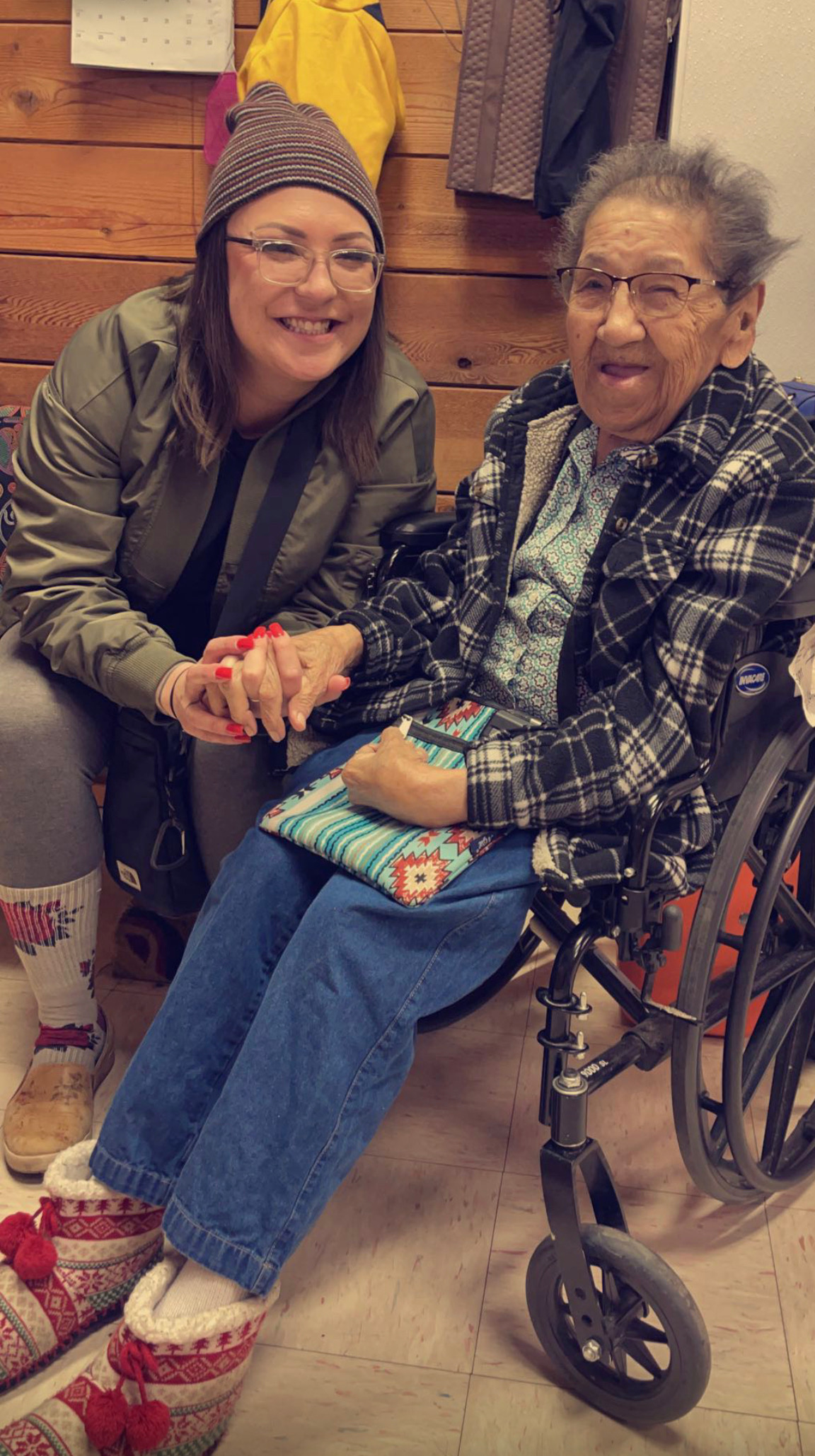
Kaadaka-iban (Elfreda) Sam will always hold a special place in Babbiitaw's heart for encouraging and supporting her quest to be a proficient Ojibwe speaker.